
 All articles
AI Makes Every Employee Smarter. The Leaders Who Win Will Make the Whole Smarter.

 October 27, 2026
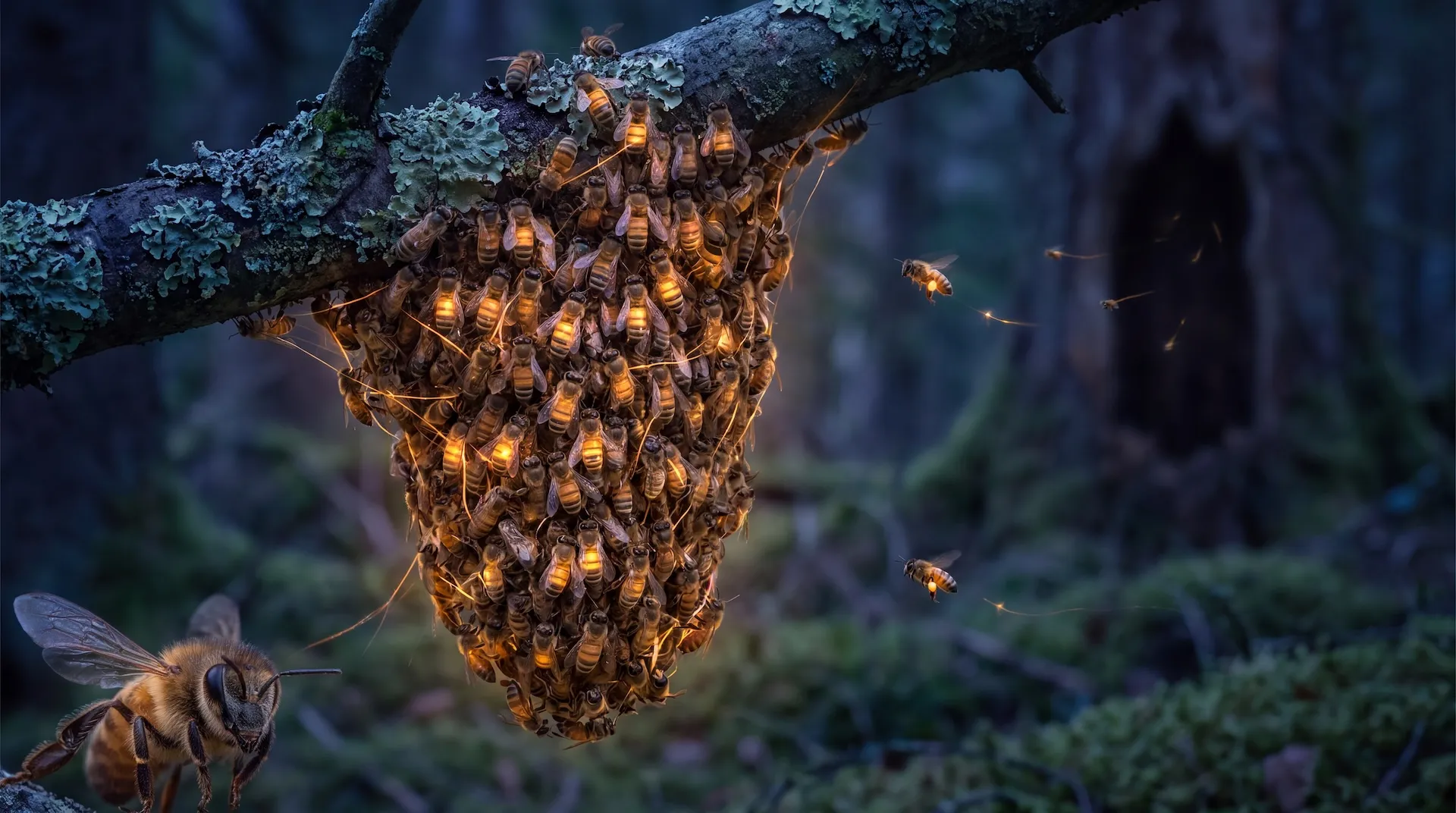
Every spring, ten thousand honeybees hang from a branch in a humming clump and decide where they will live for the next few years. No bee is in charge. They almost always get it right.
Thomas Seeley of Cornell spent decades watching how they do it. A few hundred scouts fly out to search for hollow trees. When a scout finds one, she comes back and dances for it on the surface of the swarm. The better the cavity, the longer the dance: around a hundred circuits for an excellent site, a dozen for a mediocre one. Other scouts follow the dance, fly out to judge the site for themselves and come back to dance too. Once about fifteen bees are gathered at the same site, the swarm warms up its flight muscles, lifts off and goes.
Not one bee has compared all the options. The swarm still chooses the best one.
A hive, a forest and your own body share that secret. None of them gets its strength from a single brilliant cell. The strength comes from connection, cooperation and emergence, the moment the whole starts doing something no part could manage alone.
The ladder technology climbs
In The Human Spark I describe how every wave in my 7 Wave Model answers a layer of Maslow’s hierarchy of needs. A wave takes a need, automates it and turns it into a commodity. Once something is cheap and everywhere, it stops holding our attention, and we start reaching for the need one level up.
The agricultural wave gave us irrigation, stored grain and fire for our physiological needs. The industrial wave brought railways, power lines and hospitals, and with them safety. The telecom wave let a voice cross an ocean, which served belonging. Software and operating systems made us self-sufficient and valued for what we could do: esteem. The internet and social media made knowledge free and searchable, feeding our cognitive needs.
AI is now working on layer six, our aesthetic needs. Maslow described a hunger for beauty, order and symmetry, for a life that feels balanced and well formed. Not long ago a beautiful brand identity took a designer weeks. Today you describe it in one sentence and get forty versions before your coffee cools. When beauty costs nothing, it stops setting anyone apart.
So we climb again. Layer seven is self-actualization, becoming the person you’re capable of becoming. In the book I describe the holographic wave that will serve it, with digital doubles acting as an intelligent mirror that helps us grow faster.
In his final years Maslow wrote about one more level. He called it transcendence: going beyond the self and becoming part of something larger. I see it as the first wave of the next seven-wave cycle. In plain terms, it means collaboration at a scale we’ve never pulled off before.
Where AI fits
AI can make every person in your organization stronger. Most companies are chasing that gain right now with licences and prompt training, and they should.
The bigger breakthrough comes when AI makes the whole smarter than the sum of its people. Picture AI as the waggle dance. It can carry what one scout found to everyone who needs it, translate between departments, connect the engineer in Singapore to the one in Rotterdam who’s stuck on the same problem, and keep the shared picture current. Connection gets cheap.
What travels over those connections still depends on people.
Collaboration is the new competitive advantage
In 2010 Anita Woolley and colleagues at MIT and Carnegie Mellon put 699 people into small groups and gave them a range of tasks. The groups turned out to have a measurable collective intelligence, and it had little to do with how clever the individual members were. The smartest groups had members who could read emotions in other people’s faces, and they shared speaking time more evenly. Groups with more women scored higher, partly because women scored higher on that social sensitivity.
The labor market tells the same story. Harvard economist David Deming found that jobs demanding strong social skills grew by nearly 12 percentage points as a share of US employment between 1980 and 2012, while math-heavy jobs with little human contact shrank.
We used to call these skills soft. Listening until someone has finished. Noticing the colleague who has gone quiet. Giving credit away. Disagreeing without making it personal. Trusting first. They’re the hardest skills to automate, and they decide whether a group of smart people becomes a smart group.
Whole performance
For a century leadership was a high performance game. The leader knew the most, decided the most and measured everyone on individual output. Peter Merry and Ligia Zotini call the next step whole performance: a shift from fragmented high performance toward integrated human capability, in individuals and in the systems they form together.
When every employee carries an AI that knows more than any manager, knowing the most stops being the job. The leader who stands out tomorrow sees what matters first, holds the bigger picture and helps everyone else see it too.
That leader also knows when to let go of their own site. Seeley found one more thing in the swarm. Each scout dances a little less on every return trip, even for a cavity she found herself, until she falls silent. He called it the expiration of dissent. Scouts for weaker sites stop sooner, and the swarm settles on the best home without anyone winning an argument.
That’s ego transcendence, carried out by insects with about a million neurons each. You have eighty-six billion, and for you it’s a choice. The top of Maslow’s pyramid asks every leader to do two things at once: dance for an idea with full conviction, and stop dancing once the whole has found something better.
Over to you.
Where in your organization does the whole already outperform the sum of its people, and where is someone still dancing for their own site long after the swarm has moved on? And do you expect AI to make us better at working together, or only faster at working alone?
Tell me in the comments. I read every one.
Christian Kromme writes The Human Spark – Beyond AI, a newsletter about what it means to be human in a world remade by technology.
Sources: Seeley, T.D. (2010). Honeybee Democracy. Princeton University Press. Seeley, T.D. (2003). Consensus building during nest-site selection in honey bee swarms: the expiration of dissent. Behavioral Ecology and Sociobiology, 53. Woolley, A.W. et al. (2010). Evidence for a collective intelligence factor in the performance of human groups. Science, 330(6004). Deming, D.J. (2017). The growing importance of social skills in the labor market. Quarterly Journal of Economics, 132(4). Merry, P. and Zotini, L. Whole Performers. Kromme, C. The Human Spark – Beyond AI.