
 All articles
A Yellow Blob Without a Brain Reinvented Tokyo’s Railway Network. So Why Do We Measure Ourselves Against AI?

 October 13, 2026
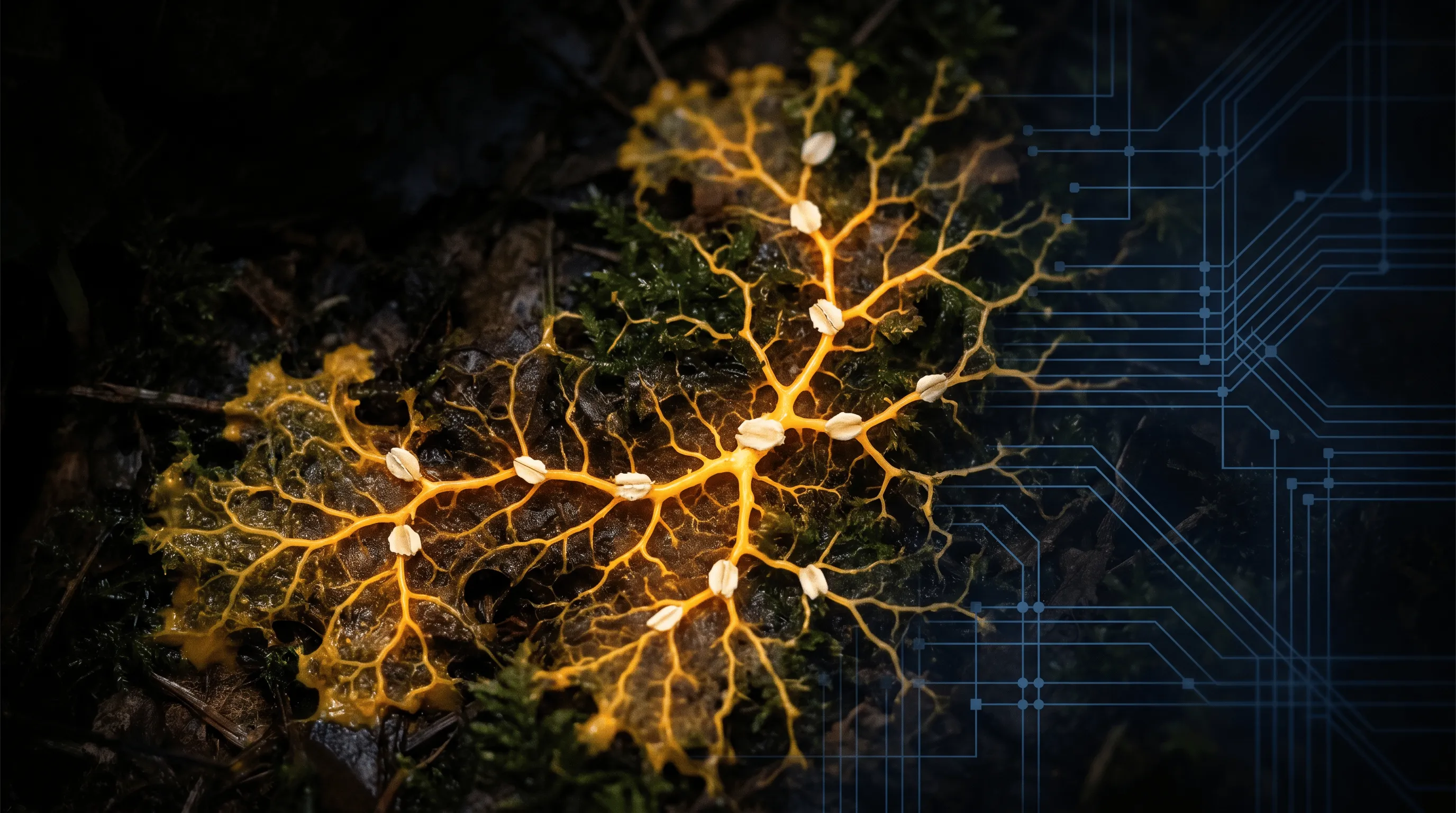
In 2010 a group of Japanese researchers scattered oat flakes across a wet plate in the pattern of the cities around Tokyo. Then they placed one small yellow organism on the spot where Tokyo would be. Within about a day it had spread in every direction, tested the routes, pulled back from the weak ones and settled on a network of tubes connecting all the food. When the team laid the result over the real rail map, the two were strikingly alike. The blob’s version was about as efficient, and in places more resilient.
The organism was Physarum polycephalum, a slime mold. It has no brain. It has no neurons at all.
Tokyo’s rail network took a century of engineering, planning and political bargaining. The slime mold did it in about a day, with nothing to think with.
I keep coming back to that experiment, because it breaks a rule most of us never knew we were following. We tie intelligence to a brain. No brain, no mind. And a growing body of research says that rule was always wrong.
Learning without a single nerve cell
Slime molds learn. In a French lab in 2016, Audrey Dussutour and her colleagues put bitter but harmless substances like quinine and caffeine between the organism and its food. At first it hesitated and crept around the edges. After a few days it worked out that the bitterness meant nothing and crossed at full speed. Take the barrier away for a while and the lesson faded, the way an unused habit fades in you.
Plants do something similar. Monica Gagliano tested Mimosa pudica, the plant that folds its leaves shut when you touch it. She dropped the potted plants a short distance, again and again. Harmless falls. After a handful of drops the plants stopped folding. They had learned that this particular disturbance carried no threat, while they still closed up when shaken in a new way. A month later they still remembered.
Then comes the strangest finding of all. Expose a Venus flytrap or a mimosa to the same anesthetics used in operating theatres and it stops responding. Touch the trap and nothing happens. Once the gas clears, it wakes up again. Chemicals we use to switch off awareness in a human body switch something off in a plant as well.
A recent piece in IAI News pulled these lines of research together under a provocative headline: consciousness in organisms without brains. I want to be careful here, and so are the scientists. Nobody can show that a plant or a slime mold experiences anything the way you do. Researchers in the field of minimal intelligence, such as Paco Calvo’s lab in Murcia, are asking a narrower and more useful question. How simple can a living thing be and still sense, choose, remember and adapt?
The answer so far: much simpler than we assumed.
We named the newest layer after the whole thing
Life was sensing, choosing and adapting for more than three billion years before anything grew a nervous system. Brains are late arrivals. The neocortex, the folded outer layer that lets you reason, calculate and write a business case, is one of the newest additions of all.
And then we did something odd. We took that newest layer and gave it the name of the whole. Intelligence became IQ, logic, verbal fluency, the things an exam can score. Everything older got pushed down the hierarchy and renamed: instinct, gut feeling, intuition, soft skills. Useful, perhaps, but never treated as serious.
Schools were built around that definition. So were hiring processes, career ladders and the way most organizations decide who gets listened to in a meeting.
Then we built machines in that same image. In my 7 Wave Model, technology follows biology layer by layer. Automation mirrors the reflexive brain that keeps a body alive. Social networks mirror the limbic brain of belonging and status. AI is the neocortex wave, the reasoning layer arriving on top of a digital body that was already built. And it is very good at the one thing we had told ourselves was the whole of intelligence.
That is why this wave feels so threatening. It came for the slice we had confused with ourselves.
Something at stake
Look at the slime mold again. A logistics algorithm can find the same efficient routes. It might find better ones. What it will never do is get hungry.
The slime mold’s network is a living answer to a problem that matters to it. Every tube it keeps and every branch it abandons is a decision about whether it goes on existing. That is the oldest form of intelligence there is: a living system with something at stake, reading its surroundings and adjusting to stay alive.
The digital stack performs every one of those functions with nobody inside. Automation keeps a company running without wanting to survive. Social platforms connect billions without anyone belonging to anyone. AI produces answers without any of them mattering to the thing that produced them.
You run on the older intelligence all day, mostly without noticing. It’s the moment you sense a negotiation has turned before anyone says a word. The quiet sense that a decision is right, or wrong, a few weeks before the numbers agree. The way an experienced nurse knows a patient is getting worse while every monitor still looks fine. Your reasoning helps you explain those moments afterwards. The signal itself comes from a living body that has been reading its world since long before it could explain anything.
What this means for the way you lead
If you hire, train and promote only for the cognitive slice, you are investing in exactly the part a machine now does faster and cheaper. The scarce material sits elsewhere: attention, timing, care, the ability to read a room and to feel the weight of a choice. Those were never on the test, so most organizations never learned to see them, let alone build them.
So start seeing them. Notice who on your team picks up trouble early. Who changes the energy of a meeting without saying much. Who adapts when the plan stops fitting reality, instead of defending the plan. That is intelligence too, and it’s the kind that has been in development for nearly four billion years.
A brainless yellow organism worked out Tokyo’s rail map in a day. Imagine what you are capable of with a whole living body behind your thinking, once you stop treating the thinking as the whole of you.
Over to you.
I read every reply. Think of a moment when you knew something before you could explain it. What did you know, and what did you do with it? And would a machine have noticed?
Tell me in the comments.
Christian Kromme writes The Human Spark – Beyond AI, a newsletter about what it means to be human in a world being reshaped by technology.
Inspired by: Lawrence, N. (2026). New studies suggest consciousness exists in organisms without brains. IAI News.